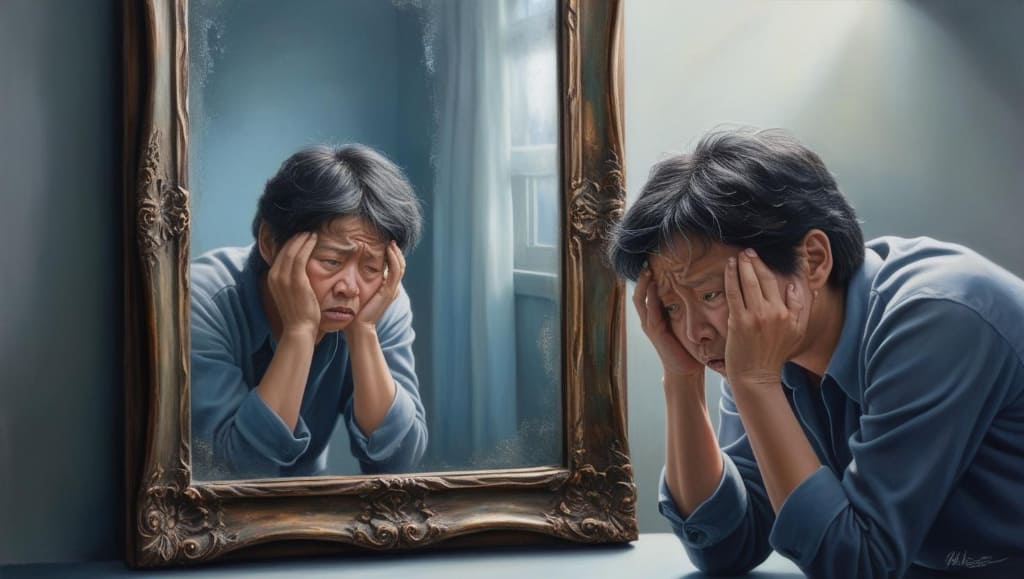
Why some people feel like “spiritual losers” (and why that’s not the truth)
If you feel like you’re failing at life, falling behind, or “not evolving” like others, this may not be failure. It may be exhaustion, overwhelm, or seeing things more clearly than most.
Then Why This Feeling Happens;
- Constant comparison to unrealistic standards
- Pressure to be positive or “healed” all the time
- Feeling different from the majority
- Burnout from trying to fit into systems that don’t fit you
Part 1: The Unseen Struggle
There’s nothing out there for non-achievers, for people who have been inactive, sedentary, uncomfortable with just being, not knowing any value without achievements, titles, and money. Mostly women, homemakers, and housewives. What about these people, living each day with shame and embarrassment, making up stories when asked, “So what do you do for a living?” or “Do you have a job?” and feeling crushed by such questions? You have to face their disapproving faces.
You have been living like a kid with zero real adult life responsibilities. You eventually come to a point in your life where you don’t have any more excuses to say because you’ve said it all. What do you do then? You hide, you cut contact, you cannot stand the echo of your pathetic answers. And the worst part is, when you go online for help, you find out that you don’t exist there either.
All these women who explain their hardships while having careers, financial stability, and independence are telling you that they’ve been there. No, they have not! You feel much, much worse. There is no one to compare yourself to, to see that you are not alone. The only thing the search for help reflects back to you is, “You are right, you really are a loser, you’ve wasted your life, you have nothing to show for it, a waste of space and resources, nothing that you did or are doing amounted to anything.” There is no cure or help for you because you should have at least done something other than sit all day.
Then those who have already achieved a lot compared to you say you deserve it all, you are worthy, you matter. How??? You agree with them because there are a lot of things you can do to change; the help is out there, the resources are out there, there are courses, side jobs, and almost all accessible and available to you through your fingertips in this age of tech and information. All this strengthens your misery. Why? You have the answer you cannot share with anyone; you don’t even want to do anything.
This confirms it all, all you’ve heard so far from others, all you’ve been told since you were born. You are a burden. One who just consumes and drains resources without contributing anything. Why aren’t you comfortable with this way of being then? You remember some people from your past. A past where you had more energy to pretend and mask your nothingness with better and somewhat believable excuses. Where you stood among those who judged the ones who were losers, who did nothing with their lives.
But you remember how those losers were so different from you. Even they were better than you. They had zero discomfort being that way. They were almost proud to be that way. You joined the ones who judged, but deep down you admired them. How do you sum up all of this? How do you make peace with admiring losers, wastes of space? How do you justify that while on the outside looking like you’ve got it all, you have access to all, and you have no physical limitations to achieve it all? You have no excuses to hide behind. No one to blame. Yet you still feel awful in each waking moment.
You cut contact with almost everyone because you no longer have answers anymore. Having abandoned all is another level of guilt you have on top of the default one. You still pretend and put up a front for the tiny amount of people still left around you. You give them just enough to make them believe you are up to something. Then in your thoughts, you are only waiting for the other shoe to drop. The very few left around you will one by one realize sooner that you are never going to do anything. They have options, they have resources, and there are countless numbers of people who can replace you and offer something or even everything.
You haven’t even enjoyed a tiny bit being the way you’ve been, and you are eerily close to the end. Your self-made bed of dying with shame and resentments. Not towards anyone or anything but the shame, guilt, and embarrassment of being you. There is help and there are resources, there are opportunities for people, but nothing for you. This isn’t a world that can help those who don’t want to help themselves. Now what?
Part 2: Beyond the Surface: Unmasking the Unexpected Traits of a “Non-Achiever”
You have an interesting set of values and different traits. Most, if not all, you downplayed, hid, or presented the opposite of your entire life. You are kind to a fault. You admire and appreciate beauty in all forms with an unmatched depth. You are childlike. You have such a deep love for playing games, which gets harder and harder by age to reveal. You hate lies; you lie too, but not even close to what and how most people do. You value directness and honesty, sometimes to a fault, in a world that often relies on nuance and unspoken implications.
You have very sharp senses. One or two of them, maybe all, are much more heightened than others. Everyday sounds can feel amplified and painful, and bright lights can be physically overwhelming. You are also very logical. You are even intellectual. When you are not trying, people die laughing at your jokes. You experience immense pleasure from things people call “meh” or get baffled by your descriptions. You were hit on and found beautiful, handsome, or attractive in your young ages, and you hardly wrapped your head around that.
Even when you consciously try to manipulate a situation or understand ulterior motives in others, that framework of self-serving intention often feels foreign or absent within yourself. You perceive things as they are. You trust like a child, too. You are loyal to a fault. You really enjoy nice things, high-tech things, or even luxury. Ironically, you don’t care about money. You have some unique skills. You are painfully considerate. The injustice you observe creates a profound and almost physical discomfort within you.
You do think, and even fantasize about not being “here” anymore, quite a lot, and this scares you, but at the same time, the act of doing it feels incredibly distant and impossible. You think to yourself, “Great! Another proof that I even contradict myself, another sign that shows me how big of a coward I am.” You cannot stand some “normal” things at a different level. Dry skin on your heel can make you cry, but not funerals. You might remain calm in chaotic situations that overwhelm others, yet the tag sticking out of a shirt collar can feel like an unbearable torment. The combination of these makes you even more embarrassed.
With skills that are not a match for monetization. Intelligence you cannot seem to utilize. Tastes and joys that are to be hidden. Values that leave you alone and broke. Tastes that people criticize. Boundaries that are seen as entitlement. Discomforts that are causing physical pain, but you have to get over them. Your physical form might appear typical to others, yet the sensations within your own skin can be overwhelming, uncomfortable, or deeply alienating. An almost constant inner restlessness, a feeling of something missing, can lead to a perpetual seeking that others might misinterpret as greed or dissatisfaction. Sudden changes in routine or plans can trigger intense anxiety or discomfort.
Part 3: Decoding Social Differences: A Surprising Key Beyond Neurodivergent Labels
It is likely that you possess documentation identifying as Neurodivergent. This realization may have occurred relatively late in life, perhaps never even considered as a possibility previously. Here, a crucial distinction warrants elucidation. While many individuals may receive a diagnosis, and conversely, many others remain undiagnosed, the current understanding of human experience continues to evolve. However, our capacity to precisely correlate measurable biological markers with the intangible, the spiritual aspects of existence, remains limited.
Fundamentally, genuinely neurodivergent individuals are born with inherent neurological differences. Their intrinsic wiring diverges significantly from that of neurotypical individuals. Consequently, the intentional infliction of harm upon others is often antithetical to their nature. It typically requires an extreme degree of external provocation for a truly neurodivergent person to knowingly direct significant anger towards another being. Furthermore, there is often an inherent awareness of wrongdoing and an aversion to confrontation, disharmony, and unnecessary conflict. A genuinely neurodivergent adult, even when significantly triggered and tested, generally does not target vulnerabilities with the intent to deeply wound.
The differentiation between these groups, while potentially subtle, becomes discernible upon closer examination. A salient criterion for understanding whether an individual is neurodivergent lies in their degree of what, for lack of a more precise term, manifests as ‘reactive externalization’ or, more bluntly, ‘assholery.’ This is not about occasional social missteps or differing personal preferences. Rather, it pertains to the deliberate, avoidable actions and words knowingly chosen to inflict hurt, driven purely by the impetus of “I am hurt, and therefore you will be too.”
A straightforward method to potentially distinguish these groups involves observing their response to personal criticism and their consistent behavior in shared living spaces. Genuinely neurodivergent individuals tend to process feedback internally, engaging in self-reflection. They may offer explanations or defenses to a degree but ultimately consider the information as material for self-analysis. Furthermore, in shared living situations, while occasional oversights like forgetting to replace the milk or missing a chore happen to everyone, a consistently neurodivergent person, when made aware, will generally strive to be mindful and adjust their behavior. Conversely, individuals who are misdiagnosed or not inherently neurodivergent may react to criticism with immediate defensiveness or aggression, often resorting to personal attacks. In shared spaces, this might manifest as a persistent disregard for the comfort and needs of others, such as repeatedly failing to contribute to household tasks despite being fully capable or consistently leaving messes without any apparent awareness or remorse, even when it’s pointed out.
Individuals sometimes mislabeled as neurodivergent may primarily prioritize their own needs and comfort without due consideration for shared spaces. Occasional oversights in communication or shared responsibilities are human. However, a consistent pattern of such behavior, despite the capacity for awareness and communication, is not indicative of neurodivergence. Similarly, the intentional infliction of physical harm on living beings is not a characteristic of neurodivergence. Furthermore, a consistent pattern of disregard for shared environments through pollution, damage, waste, or an expectation of service without contribution is also not indicative of neurodivergence.
What, then, might be the underlying factors in such cases? Trauma or complex post-traumatic stress disorder (CPTSD) are possibilities. The struggles experienced are undeniably real, but the guiding framework may have been misapplied. Upon receiving genuine, well-intentioned course correction aimed at fostering growth and healing, significant positive change is often possible. Indeed, the world tends to embrace and celebrate such transformative journeys. Moreover, the societal structure is largely designed by and for neurotypical individuals, suggesting a greater potential for integration and well-being following trauma-informed healing.
Ultimately, the inherent value and importance of every living being remain constant. Each creation, as long as it exists, holds a vital place within the larger ecosystem. Knowingly obscuring one’s situation behind the experiences of the truly less fortunate ultimately burdens the collective well-being of all inhabitants of this shared world.
Part 4: Beyond Gold and Glory: A King’s Quest for True Happiness
Seemingly a digression, we now turn the page to a little tale, one whispered through the ages of a king drowning in his own gilded cage and the unlikely answer he sought from the dust of the earth. Its origins are as hazy as the morning mist, yet its resonance lingers like the scent of rain.
Our focus settles upon a monarch whose reign stretched back through the decades, his power a granite edifice against the shifting sands of time. The vaults overflowed with treasures that shimmered with captured sunlight, a wealth so vast it existed only as an abstract number in the royal ledgers. His kingdom, a sprawling tapestry of conquered lands and loyal provinces, kissed the horizons in every direction. He possessed all that mortal men could crave: mountains of jewels, armies at his command, and palaces that echoed with the hushed reverence of his court. Yet, within this abundance, a single, gnawing absence festered: happiness.
A weariness clung to him like the heavy velvet of his robes. The jesters’ antics, once a source of fleeting amusement, now grated on his ears like discordant music. Lavish gifts lay unopened, their allure dulled by the persistent ache within. Even the triumphant pronouncements of newly claimed territories, once met with booming pronouncements of pride, now landed on his soul with the weight of dry dust. Another sleepless dawn painted the eastern sky in hues of indifference, and the king, his spirit a parched wasteland, summoned his most trusted advisors.
His decree cut through the pre-dawn stillness: find him the happiest man in all the world. Distance was no matter, nor the years it might take. Every resource within his boundless kingdom was theirs to command. Let no stone be left unturned, no path unexplored. The quest for a single spark of genuine joy had begun, fueled by a king’s desperate yearning and the unwavering loyalty (and perhaps a touch of fear) of his most devoted men.
The king’s men journeyed for years, their search leading them through bustling cities and quiet villages, across sun-drenched plains and over snow-capped mountains. They spoke to merchants and farmers, to scholars and laborers, always asking the same question: “Who is the happiest person you know?” Many offered names of those who seemed content, but none resonated with the profound, unwavering joy the king sought.
Finally, in a place they least expected, a small, unassuming village nestled far from the opulent centers of the kingdom, one of the king’s men stumbled upon a man unlike any other. Everyone in the village knew this poor soul. They described him as unique, someone whose spirit seemed untouched by the hardships he had endured. He owned nothing of value. His dwelling was a simple shack, barely holding together against the elements. He had no family, having grown up an orphan, passed from one reluctant hand to another. He knew hunger and neglect, his meager possessions often stolen. Yet, despite a life that seemed steeped in misfortune, this man carried within him an unshakeable joy.
Those who had known him for years recounted never seeing him frown. A gentle, kind smile perpetually graced his lips. He would laugh with such ease and genuine delight that it often bewildered those around him, who saw little reason for such merriment in their own hard lives. This man, seemingly the poorest and most ill-fated soul on earth, radiated an undeniable happiness.
The king’s messenger, after carefully verifying these accounts from countless villagers, approached the happy man. He explained the extraordinary destiny that awaited him: an audience with the king and the promise of unimaginable wealth if he could share the secret of his joy. The poor man, surprisingly tall and robust despite his meager existence, listened with a quiet curiosity. He agreed to accompany the king’s man to the palace, unaware of the life-altering events that lay ahead.
When the poor man arrived at the grand palace, the king greeted him with a mixture of hope and skepticism. Could this simple villager truly hold the key to a happiness that had eluded him his entire life? The poor man, unfazed by the opulent surroundings, simply smiled and nodded when the king posed his desperate question. He wasn’t a man of many words. The king, observing his unassuming demeanor, felt a flicker of doubt, yet the exhaustive search of his men offered a sliver of hope he couldn’t ignore.
The poor man, after a moment of quiet contemplation, addressed the king. “Your Majesty,” he said, his voice calm and steady, “I have but one condition. For the next seven days, you must do exactly as I ask, without question or hesitation, for a specific duration each day.” The king, his inner turmoil a raging storm, grasped at this fragile thread of possibility and readily agreed to the seemingly simple request from this enigmatic villager.
That evening, the poor man requested a modest chamber where he could gather his thoughts. He assured the king that by noon the following day, he would present a method to unlock the doors to true happiness. The king, his anticipation a heavy weight in his chest, could only nod, the days of his joyless existence hanging in the balance of this strange encounter.
True to his word, before the sun reached its zenith, the poor man stood before the restless king. The king, his eyes shadowed with anticipation, leaned forward on his throne. “Speak at once,” he urged, his voice tight with a desperate hope he tried to conceal. “What is the secret to this happiness that has eluded me?”
The poor man, his gentle smile unwavering, opened his mouth and said, “The key to real happiness, Your Majesty, is being able to eat well, drink your fill, and then… have a good shit every day.”
A stunned silence descended upon the throne room. A young servant near the back stifled a giggle, earning a sharp glare from a nearby courtier. The king’s face, moments before etched with anticipation, now contorted in disbelief and then a burgeoning fury.
“That… that is it?” he hissed, his voice dangerously low. “You drag me through years of searching, you raise my hopes with your serene countenance, and the profound wisdom you offer is… basic bodily functions?”
The poor man, unfazed by the king’s mounting anger, simply nodded, his smile still serene. “It is the foundation upon which all else rests, Your Majesty. A simple truth often overlooked in the pursuit of grander things.”
The king’s rage flared. “Seven days?” he spat, the word laced with menace. “You have seven days to prove the worth of this… vulgar pronouncement. If, at the end of that time, I do not understand this… philosophy, your end will be neither swift nor merciful.”
The poor man’s unwavering confidence seemed to momentarily quell the king’s fury. “Seven days, Your Majesty. I ask only that you follow my instructions each day.”
The poor man’s first instruction was simple: the king was to feast as never before, indulging in the richest foods and finest wines until he could consume no more. He was also to enjoy the company of those he had long neglected in his royal duties. The king, still simmering with disbelief but intrigued by the audacity of the request, complied. He ate and drank to excess, the fleeting pleasure doing little to soothe his underlying discontent.
The following days followed a similar pattern. Each day, the poor man instructed the king to partake in another lavish feast, with different delicacies and different guests. The king obeyed, a growing discomfort beginning to accompany the overindulgence. He found himself increasingly sluggish and irritable, the promised happiness remaining stubbornly out of reach.
By the fourth day, the king’s physical state was markedly worse. His clothes felt tight, a dull ache persisted in his abdomen, and an unfamiliar lethargy made even the simplest tasks a burden. He regarded the poor man with a mixture of suspicion and a grudging curiosity. What was the purpose of this gluttonous exercise?
The sixth day arrived, and the king was truly miserable. His temper was frayed, his patience exhausted. He moved with difficulty, the once-anticipated feasts now feeling like a cruel torment. He longed for his former routine, even in its joyless monotony. An unsettling physical sensation, a profound lack of a natural bodily function, began to add to his distress, though he couldn’t quite place its origin.
Finally, the seventh day dawned. The king, pale and drawn, sat heavily upon his throne, his discomfort bordering on agony. The poor man approached, his usual gentle smile in place, and offered him a simple cup. “Drink this, Your Majesty,” he said softly.
The king, desperate for any form of relief from his mounting and inexplicable suffering, drank the bland liquid. Almost immediately, a strange gurgling stirred within him, followed by an urgent and undeniable need. With a speed that surprised even himself, the king practically fled towards his private chambers.
Time stretched into an eternity for the anxious courtiers. Then, the resounding slam of the king’s chamber doors. Moments later, the king reappeared, his face transformed. The pallor was gone, replaced by a radiant joy that lit up his entire being. Tears streamed down his face, not of sorrow, but of pure, unadulterated relief. He rushed to the poor man and embraced him, a deep, unrestrained laugh echoing through the hall.
“You were right!” the king exclaimed, his voice filled with awe. “This… this simple feeling! I had forgotten its power!”
Only then did the poor man explain his methods. He revealed the subtle potion he had requested, the one that had temporarily inhibited a fundamental bodily process. By experiencing the profound misery of its absence, the king could now truly appreciate the immense joy of its return. The seven days of feasting had merely exacerbated the underlying issue, making the eventual relief all the more powerful.
The king, humbled and enlightened, showered the poor man with riches. The villager, his simple wisdom having moved a monarch, used his wealth to bring comfort to his community, living out his days with the same quiet happiness that had once captivated a king.
Part 5: The Glorious Loser: Finding Value in the Unconventional Path
The tale of the king and the poor man, in its unconventional way, brings a stark clarity. The message that resonates, stripped bare of societal expectations, is this: you are the shit.
You are a glorious loser. You have nothing to show for. You haven’t enjoyed even a tiny bit of your existence. You are still heading towards your self-made bed of shame and resentments. You are still aware of all the help and resources out there for you, but you still don’t want to do anything. You are still a contradiction. You still don’t understand why you are not comfortable with all of this. You still remember those you admired from afar. You still have no answers for the simplest questions. You still feel guilty for cutting contact. You still put up a front. You are still waiting for the other shoe to drop. You are still aware of the clock ticking. You are still you.
But now you have read all of this. You have spent your precious time reading something about someone exactly like you. Maybe you are not alone? Maybe there is one other essence in this world experiencing a similar play? Maybe you are not such a unique facet of the divine after all? Maybe there is a tiny stirring of recognition in this? Maybe you are not completely unseen by the Source?
And just like the very thing our bodies must release—something often considered unpleasant, even repulsive, yet utterly essential for the vessel’s well-being—your current expression, in its rawest form, is part of a grander design. It takes a certain kind of steadfastness, a quiet commitment, for your essence to fully inhabit this role in the human experience. To willingly remain behind the perceived achievements, to experience a lifetime within these self-defined limitations. You may never fully grasp the intricate ways your chosen path subtly shifts the experiences of other essences along their own journeys. You may never receive the external validation that aligns with worldly measures of success.
Perhaps the persistent external calls for transformation never truly resonated because your essence entered this play with a different script, a pre-agreed arc that doesn’t necessitate those changes. When your essence has a true resonance with a particular action or direction, a deep “knowing” ignites a powerful drive, akin to a tiger with its prey – an unwavering focus and commitment. The absence of that fierce inner pull towards the changes others advocate might simply reflect a different, preordained trajectory. This understanding offers a profound acceptance of the present moment. You are still here. You are still breathing. You are still capable of observing. You are still you. And perhaps, in this intricate and forgotten agreement, that is precisely enough.